











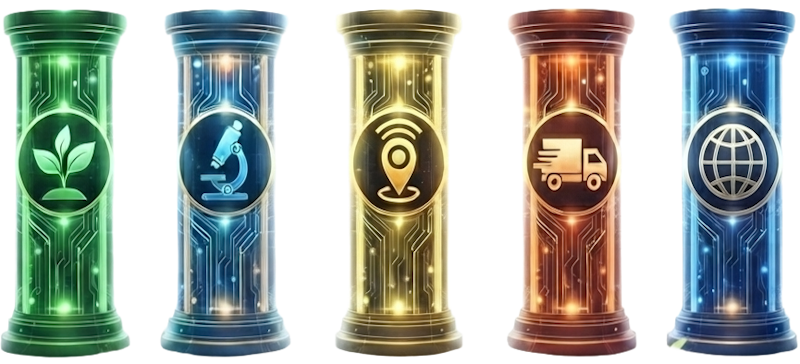
What Is AgriAI? How Artificial Intelligence Is Transforming Agriculture?
Published: · Kosona Chriv
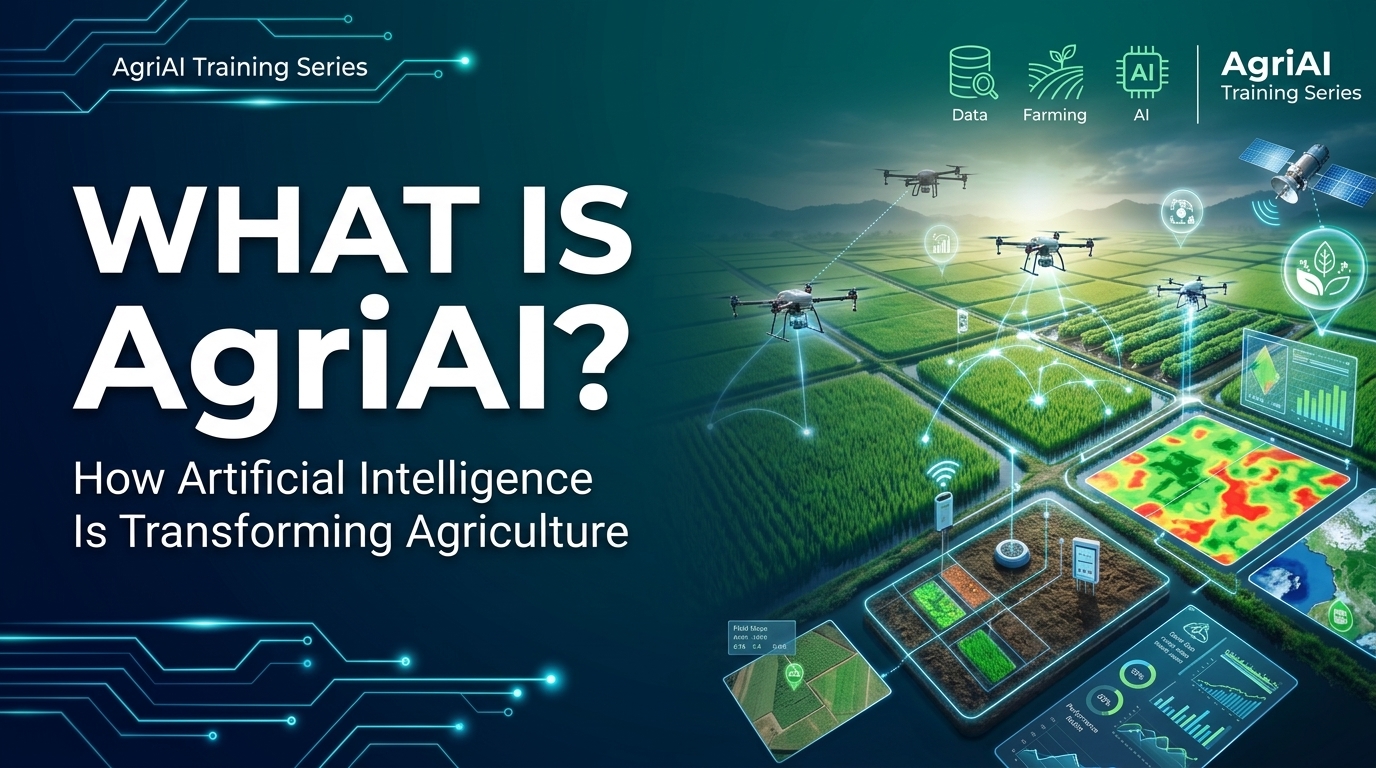
AgriAI (Agricultural Artificial Intelligence) refers to the application of AI technologies—including machine learning, computer vision, natural language processing, robotics, and predictive analytics—to optimize, automate, and enhance every aspect of agricultural production, processing, distribution, and management. In simpler terms, AgriAI means teaching machines to see, think, decide, and act in agricultural contexts, much like an experienced farmer would, but at a speed, scale, and precision that surpasses human capability.
Duration: 30 minutes
Target Audience: Students, agricultural professionals, technology enthusiasts, policy-makers
Prerequisites: None – introductory level
📋 LEARNING OBJECTIVES
By the end of this course, participants will be able to:
Define AgriAI and explain its core components.
Describe the key AI technologies applied in agriculture.
Identify how AI transforms each stage of the agricultural value chain.
Recognize the benefits, limitations, and ethical considerations of AgriAI.
Understand the future trajectory of AI in agriculture.
⏱️ MODULE 1 – INTRODUCTION & CONTEXT (3 minutes)
1.1 Why This Topic Matters Now
The world faces an unprecedented challenge: by 2050, the global population is projected to reach 9.7 billion people, requiring an estimated 60–70% increase in food production. At the same time, agriculture confronts:
Climate change – unpredictable weather, droughts, floods, and shifting pest patterns.
Resource scarcity – declining arable land, water stress, and soil degradation.
Labor shortages – rural-to-urban migration reducing the available farming workforce.
Sustainability pressure – the need to produce more with fewer chemical inputs.
Traditional farming methods alone cannot meet these demands. This is where Artificial Intelligence (AI) enters the picture, offering data-driven, scalable, and precise solutions.
1.2 A Brief Historical Perspective
Era
Agricultural Revolution
Key Innovation
~10,000 BC
1st – Domestication
Seeds, irrigation
18th–19th c.
2nd – Mechanization
Tractors, fertilizers
1960s–70s
3rd – Green Revolution
High-yield varieties, pesticides
2010s–present
4th – Digital / AI Revolution
Sensors, drones, machine learning, robotics
AgriAI is the engine of this 4th Agricultural Revolution (often called Agriculture 4.0).
⏱️ MODULE 2 – WHAT IS AGRIAI? DEFINITION & FUNDAMENTALS (5 minutes)
2.1 Defining AgriAI
AgriAI (Agricultural Artificial Intelligence) refers to the application of AI technologies—including machine learning, computer vision, natural language processing, robotics, and predictive analytics—to optimize, automate, and enhance every aspect of agricultural production, processing, distribution, and management.
In simpler terms, AgriAI means teaching machines to see, think, decide, and act in agricultural contexts, much like an experienced farmer would, but at a speed, scale, and precision that surpasses human capability.
2.2 Core Pillars of AgriAI
AgriAI rests on four foundational pillars:
Data – The raw material. Soil readings, satellite imagery, weather records, crop yields, market prices, livestock vitals, etc.
Algorithms & Models – Machine-learning and deep-learning models that learn patterns from data.
Connectivity & Infrastructure – IoT sensors, GPS, cloud computing, 4G/5G networks that collect and transmit data.
Action / Actuation – Robotics, automated irrigation systems, variable-rate sprayers, drones, and decision-support dashboards that turn insights into real-world actions.
2.3 Key AI Sub-Fields Used in AgriAI
AI Sub-Field
Role in Agriculture
Example
Machine Learning (ML)
Pattern recognition, prediction
Yield forecasting, disease prediction
Computer Vision (CV)
Image/video analysis
Weed detection, fruit grading, livestock monitoring
Natural Language Processing (NLP)
Understanding human language
Farmer chatbots, advisory apps in local languages
Robotics & Automation
Physical tasks
Autonomous tractors, robotic harvesters
Deep Learning / Neural Networks
Complex image & sensor analysis
Satellite-based crop health mapping
Reinforcement Learning
Optimizing sequential decisions
Irrigation scheduling, feeding strategies
Generative AI
Creating content, scenario modelling
Synthetic weather data, advisory report generation
2.4 How AgriAI Differs from Traditional Precision Agriculture
Precision Agriculture (1990s–2010s): Relied on GPS, GIS, and basic sensors. Decisions were largely rule-based.
AgriAI (2010s–present): Adds learning and autonomy. Systems improve over time, handle unstructured data (images, speech), and can make or recommend decisions with minimal human input.
Key takeaway: AgriAI = Precision Agriculture + Machine Intelligence + Autonomy.
⏱️ MODULE 3 – HOW AGRIAI WORKS: THE DATA-TO-ACTION PIPELINE (7 minutes)
3.1 The AgriAI Pipeline (Step by Step)
Think of AgriAI as a five-step pipeline:
[1] DATA COLLECTION

        ↓

[2] DATA TRANSMISSION & STORAGE

        ↓

[3] DATA PROCESSING & ANALYSIS (AI/ML Models)

        ↓

[4] INSIGHT GENERATION & DECISION

        ↓

[5] ACTION & ACTUATION

        ↓

   (Feedback loop → back to step 1)
Let's walk through each step.
Step 1 – Data Collection
In-field sensors: Soil moisture probes, pH sensors, nutrient sensors, weather stations.
Aerial/space sensors: Drones (UAVs) with multispectral or thermal cameras; satellites (Sentinel-2, Landsat, Planet Labs).
Ground imagery: Smartphone photos of leaves, fruits, or pests.
Livestock wearables: RFID tags, accelerometers, GPS collars.
External data feeds: Weather APIs, commodity-market prices, satellite rainfall data.
Step 2 – Data Transmission & Storage
IoT gateways, LoRaWAN, cellular (4G/5G), or satellite links push data to cloud platforms (AWS, Azure, GCP) or edge servers on the farm.
Data lakes and time-series databases store historical records for model training.
Step 3 – Data Processing & AI Analysis
Pre-processing: Cleaning, normalizing, augmenting images, handling missing values.
Model training: Supervised learning (labelled disease images), unsupervised learning (clustering soil types), or reinforcement learning (optimizing irrigation).
Inference: Trained models run on new data to produce predictions (e.g., "There is an 87% probability of late blight in Plot 4").
Step 4 – Insight Generation & Decision
Dashboards, mobile alerts, or voice messages translate model outputs into actionable recommendations for farmers.
Example: "Apply 12 kg/ha of nitrogen only on the northern strip; the southern strip is already sufficient."
Step 5 – Action & Actuation
Automated: Variable-rate applicators, autonomous sprayers, robotic weeders, smart irrigation valves.
Semi-automated: Farmer approves a recommendation via a tablet before a drone sprays.
Manual: Farmer receives an advisory and acts on it.
A feedback loop captures the outcome (actual yield, disease progression, water saved) and feeds it back into the model for continuous improvement.
3.2 Enabling Technologies in More Detail
IoT (Internet of Things): Network of low-cost, low-power sensors in the field.
Edge Computing: Processing data locally on the farm to reduce latency (critical for autonomous tractors).
Cloud Computing: Scalable storage and heavy model training.
5G / Satellite Connectivity (e.g., Starlink): Enables real-time data from remote farms.
Blockchain (complementary): Traceability of AI-driven decisions for certification and compliance.
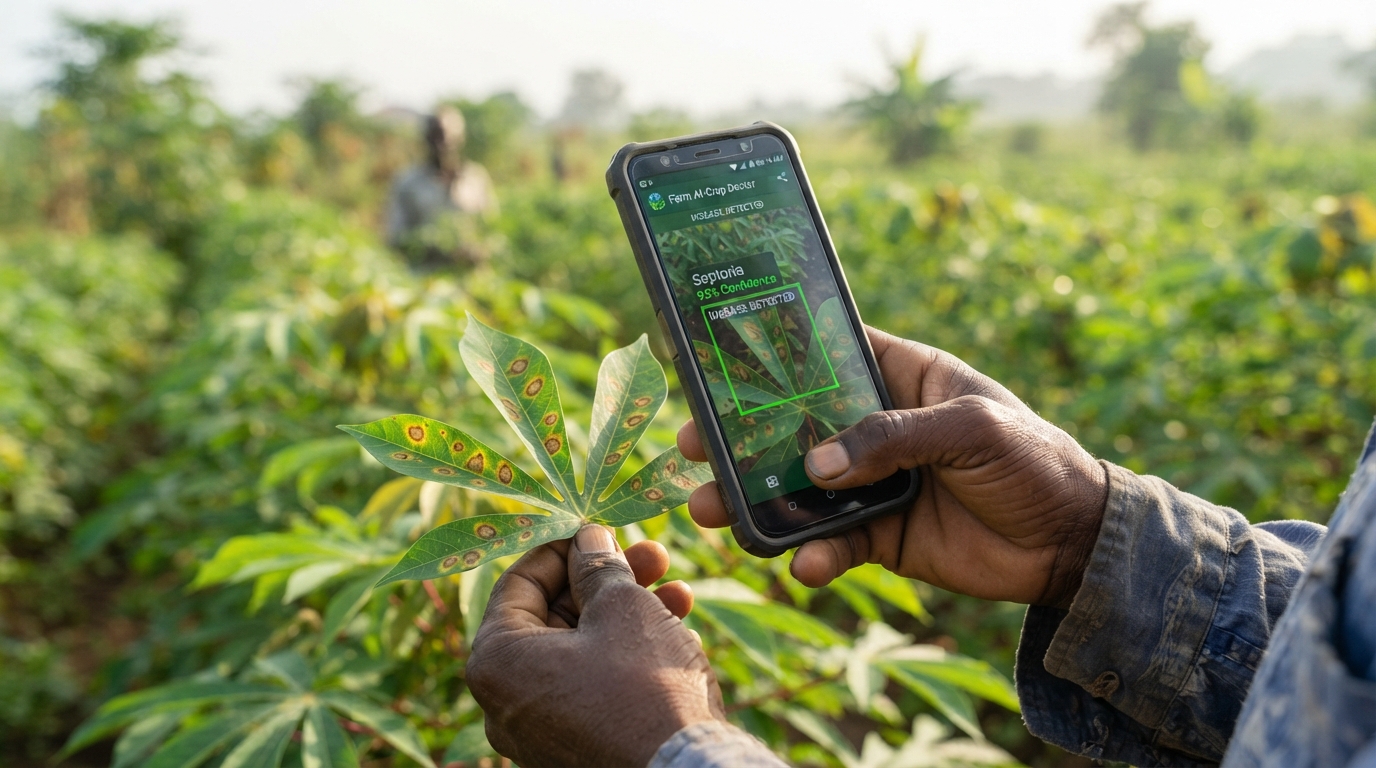
3.3 A Concrete Example – Wheat Disease Detection
A farmer photographs wheat leaves with a smartphone.
The image is uploaded to a cloud server.
A Convolutional Neural Network (CNN), trained on 200,000 labelled images of wheat diseases, analyses the photo.
Within 3 seconds, the app returns: "Septoria leaf blotch detected – confidence 93%. Recommended fungicide: X, dosage: Y."
The farmer sprays only the affected area, saving chemicals and protecting yield.
⏱️ MODULE 4 – AI ACROSS THE AGRICULTURAL VALUE CHAIN (8 minutes)
The agricultural value chain spans from pre-planting to the consumer's plate. AI touches every link.
4.1 Pre-Production / Planning
Application
AI Technique
Impact
Crop-selection & rotation planning
Predictive analytics, optimization algorithms
Match crop to soil, climate, and market demand
Soil health mapping
ML on sensor + satellite data
Identify nutrient deficits per square metre
Weather & climate forecasting
Deep learning on historical meteorological data
Reduce risk of planting at wrong time
Seed & input recommendation
Recommendation engines
Personalized advice per farm
4.2 Crop Production (In-Field)
Precision planting: AI-guided planters adjust seed depth and spacing in real time.
Smart irrigation: Soil-moisture sensors + ML models trigger drip irrigation only when and where needed → 20–40% water savings.
Weed, pest & disease management: Computer-vision drones identify weeds; AI-driven sprayers apply herbicide only on weeds (e.g., John Deere's "See & Spray", Carbon Robotics' LaserWeeder) → up to 90% reduction in herbicide use.
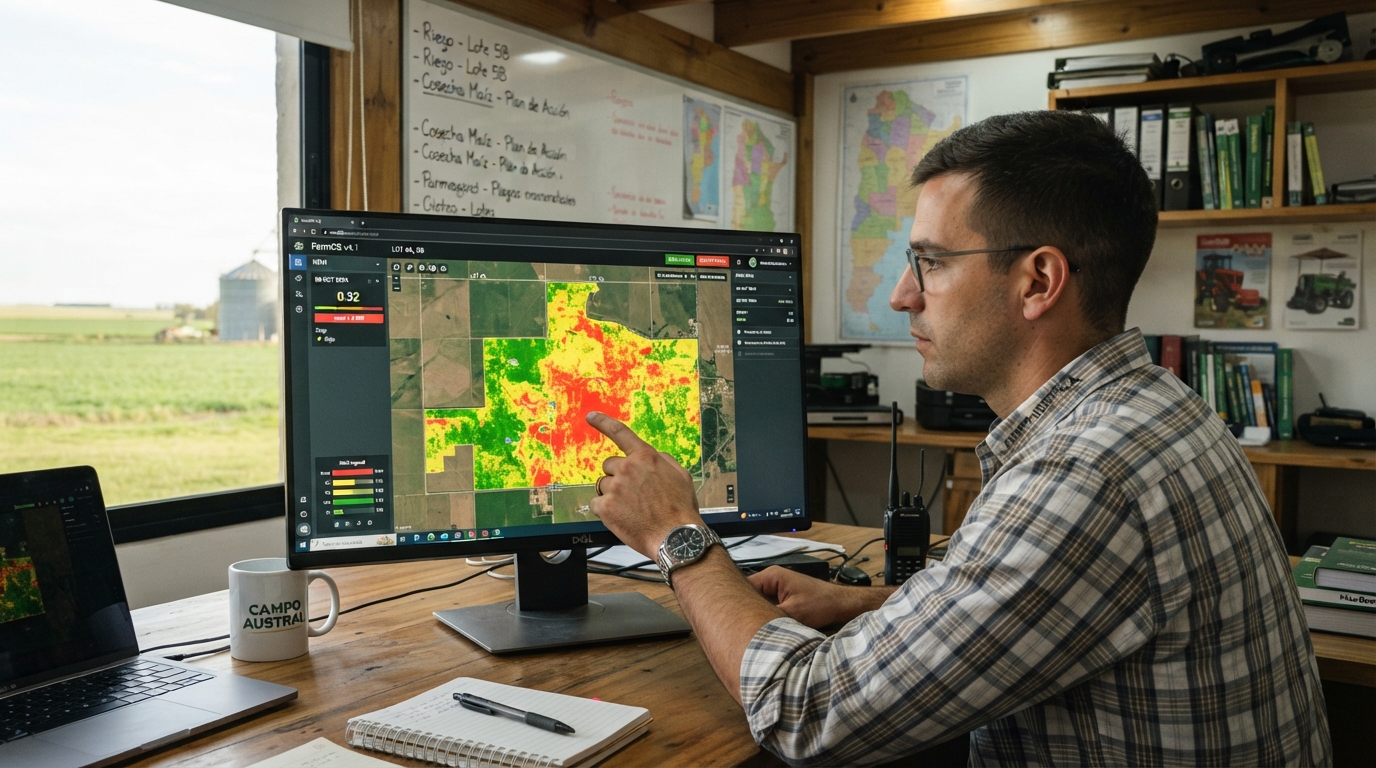
Crop-health monitoring: Multispectral drone/satellite imagery + NDVI analysis detect stress before the human eye can.
Yield prediction: ML models combining weather, soil, and imagery data forecast yields weeks before harvest, aiding logistics and market planning.
4.3 Livestock & Aquaculture
Individual animal monitoring: Computer vision + accelerometers detect lameness, estrus, or illness early.
Automated feeding: AI adjusts feed rations per animal, reducing waste.
Aquaculture: Underwater cameras + AI estimate fish biomass, detect parasites, and optimize feeding schedules.
4.4 Harvesting & Post-Harvest
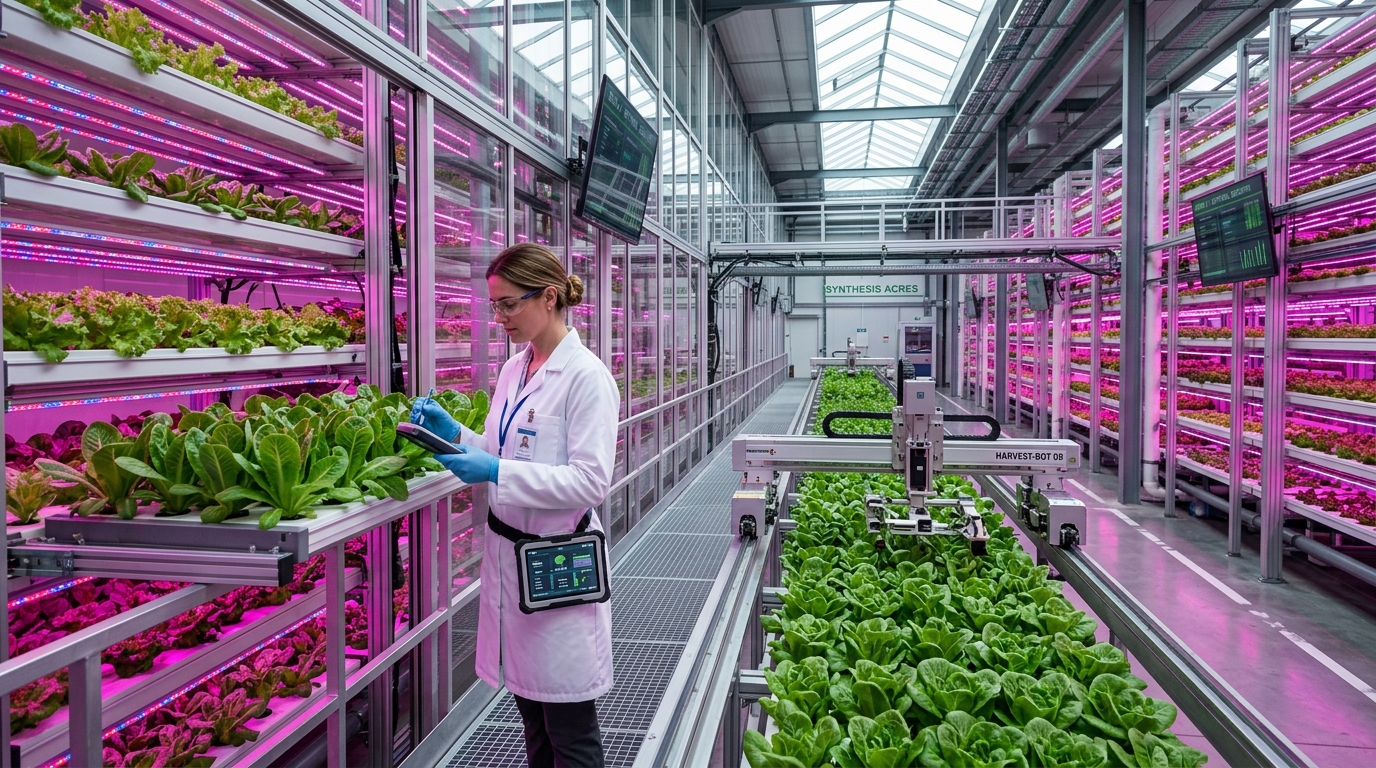
Robotic harvesting: Vision-guided robots pick strawberries, tomatoes, apples, reducing dependency on seasonal labour.
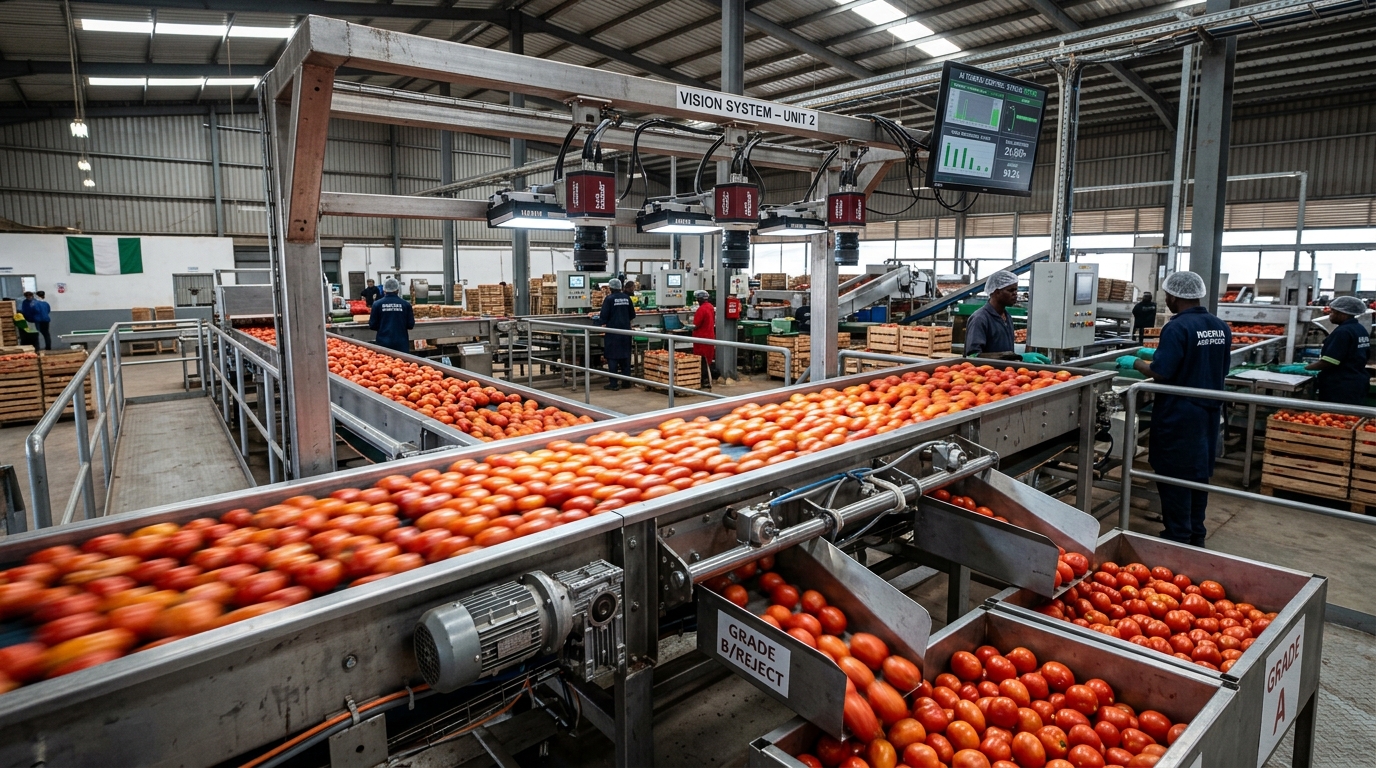
Grading & sorting: High-speed cameras + deep learning sort fruits/vegetables by size, colour, and defects on conveyor belts.
Storage optimization: AI predicts spoilage risk in grain silos, cold-storage warehouses, adjusting temperature/humidity proactively.
4.5 Supply Chain, Processing & Distribution
Demand forecasting: ML predicts consumer demand, reducing food waste.
Logistics optimization: Route-planning algorithms cut transport time and carbon footprint.
Quality inspection: Computer vision on processing lines detects contaminants or defects.
Traceability: AI + blockchain track produce from farm to fork.
4.6 Market Access, Finance & Advisory
Price prediction: NLP scrapes news, reports, and market data to forecast commodity prices.
Credit scoring for smallholders: Alternative data (satellite yield history, mobile-money transactions) + ML models extend credit to unbanked farmers.
AI-powered advisory (Agri-chatbots): WhatsApp or voice-based bots deliver localized agronomic advice in local languages (e.g., IBM's "Watson Decision Platform for Agriculture", India's "Kisan Suvidha").
4.7 Policy, Research & Sustainability
Carbon accounting: AI quantifies soil carbon sequestration for carbon-credit markets.
Biodiversity monitoring: Acoustic AI identifies insect and bird populations.
Climate-adaptation research: ML accelerates plant-breeding by predicting trait outcomes from genomic data (genomic selection).
Key takeaway: AgriAI is not a single tool; it is a horizontal enabler that permeates every stage from seed to shelf.
⏱️ MODULE 5 – BENEFITS, CHALLENGES & ETHICAL CONSIDERATIONS (4 minutes)
5.1 Benefits
Higher productivity – more output per hectare, per litre of water, per kg of input.
Sustainability – fewer chemicals, less water, lower greenhouse-gas emissions.
Resilience – early warning of pests, diseases, and extreme weather.
Labour mitigation – automation addresses seasonal-worker shortages.
Economic inclusion – mobile AI advisory reaches smallholder farmers previously excluded from extension services.
Reduced food waste – better forecasting, sorting, and storage.
5.2 Challenges & Barriers
Challenge
Detail
Data availability & quality
Small farms may lack sensors; datasets may be biased toward large, industrial farms.
Connectivity
Rural areas often have poor internet.
Cost & accessibility
High upfront cost of drones, robots; subscription fees for AI platforms.
Digital literacy
Farmers need training to interpret and trust AI outputs.
Model bias & generalizability
A model trained on Kansas wheat may fail on Ethiopian teff.
Interoperability
Proprietary data silos; lack of open standards.
Regulatory gaps
Drone flight rules, data-privacy laws, liability for autonomous machinery.
5.3 Ethical & Social Considerations
Data ownership: Who owns farm data – the farmer, the sensor company, or the AI platform?
Job displacement vs. creation: Automation may reduce manual jobs but create new roles (drone pilots, data analysts).
Equity: Ensuring smallholders in the Global South benefit, not just large agribusinesses.
Transparency & explainability: Farmers need to understand why an AI recommends a certain action ("Explainable AI" – XAI).
Environmental trade-offs: E-waste from sensors; energy cost of training large models.
5.4 Future Outlook (2025–2035)
Autonomous farm fleets: Swarms of small, AI-driven robots replacing large tractors.
Foundation models for agriculture: Large multimodal models trained on petabytes of agricultural data, offering universal crop advisory.
Digital twins of farms: Real-time virtual replicas for simulation and scenario planning.
Integration with gene editing & synthetic biology: AI accelerates development of climate-resilient crop varieties.
AgriAI-as-a-Service: Pay-per-use AI tools accessible via basic smartphones, democratizing access.
⏱️ MODULE 6 – SUMMARY & KEY TAKEAWAYS (3 minutes)
Let's recap the five essential messages of this course:
AgriAI = AI technologies applied across the full agricultural value chain, from soil to consumer.
It works through a data → model → insight → action pipeline, powered by IoT, cloud/edge computing, ML, computer vision, and robotics.
AI is transforming every stage: planning, planting, crop care, livestock management, harvesting, processing, logistics, marketing, and policy.
The benefits—productivity, sustainability, resilience, inclusion—are enormous, but challenges around data, cost, literacy, and ethics must be addressed.
The future points toward autonomous, connected, and AI-native farming systems, accessible to farmers of all scales.
"AI will not replace farmers, but farmers who use AI will replace those who don't."
Documents
Five Pillars AI Academy provides free online courses designed to help professionals, farmers, cooperatives, agribusinesses, processors, traders, exporters, and other stakeholders in the agricultural value chain understand and apply Artificial Intelligence in their daily work.
Our curriculum covers eight key areas:
1. 🌱 AgriAI Fundamentals
Learn the foundations of Artificial Intelligence and discover how AI is transforming modern agriculture—from farming and processing to trade and market intelligence.
2. 🤖 AI for Agribusiness
Discover practical AI applications for agribusiness management, sales, marketing, finance, decision-making, customer engagement, and business growth.
3. 📊 AI-Powered Agricultural Operations
Learn how AI, data, IoT, and automation can optimize farming, production, quality control, resource management, and operational performance.
4. 🌍 Global AgriTrade & Export Compliance
Learn how AI-powered tools can support international agricultural trade, market intelligence, documentation, traceability, and export compliance.
5. 🏭 AI Factory & Smart Processing
Explore how AI, computer vision, automation, and real-time data can transform agro-processing facilities into smarter, more efficient, and more profitable operations.
6. 🚜 AI for Cooperatives & Farmers
Discover how farmers and cooperatives can use AI for crop monitoring, disease detection, production planning, market access, pricing intelligence, and better decision-making.
7. 📦 AI-Powered Supply Chain
Learn how AI can improve agricultural supply chains through demand forecasting, logistics optimization, inventory management, traceability, quality control, and risk management.
8. 🎓 Five Pillars Professional Certifications
Develop industry-focused knowledge and practical skills in AgriAI, smart agriculture, agribusiness, international trade, and AI-powered operations.
🌍 Who is it for?
Our free training is intended for everyone working in or supporting the agricultural value chain, including farmers, cooperatives, agribusiness professionals, processors, traders, exporters, logistics professionals, consultants, students, and agricultural organizations.
🎓 100% Free Training
All courses are provided free of charge, with the goal of making practical AgriAI knowledge accessible to people and organizations around the world.
👉 Explore the free curriculum: https://academy.adalidda.com
Learn AI. Apply AI. Transform Agriculture. 🌱🤖🌍
Mr. Kosona Chriv is the Founder of Five Pillars AgriAI, Five Pillars AI Park, and Five Pillars AI Academy—three complementary initiatives designed to accelerate the digital transformation, industrialization, and global competitiveness of the agricultural sector.
Five Pillars AgriAI
Five Pillars AgriAI is an enterprise-grade, multi-tenant AgriAI platform designed to digitize agricultural and agribusiness operations and transform agricultural data into actionable intelligence.
The platform connects the entire agricultural and export value chain—including production planning, quality management, compliance, traceability, logistics, communication, sales, and executive intelligence—within one integrated digital ecosystem.
Built around the Five Pillars Framework, Five Pillars AgriAI helps agricultural organizations strengthen:
Production Planning and Volume Consistency
Quality Management and Compliance
Traceability and Due Diligence
Logistics and Documentation
Digital Communication and Export Readiness
By combining AI-powered recommendations, GPS polygon mapping, agricultural traceability, compliance management, multilingual communication, Vision AI, Voice AI, sales intelligence, and executive analytics, Five Pillars AgriAI enables farmers, cooperatives, agribusinesses, processors, exporters, and agricultural institutions to improve operational efficiency, build buyer confidence, and compete more effectively in international markets.
Five Pillars AI Park
Five Pillars AI Park extends the Five Pillars AgriAI technology framework beyond individual agricultural organizations into a complete AI-enabled agro-industrial ecosystem.
The concept integrates agricultural supply chains, value-added processing, renewable energy, circular-economy solutions, AI data centers, digital infrastructure, logistics, traceability, and international market access within a unified agro-industrial park.
At the heart of the Park is the concept of the AI Factory—where advanced AI, edge computing, IoT, computer vision, automation, and real-time data intelligence support agricultural processing and industrial operations.
The Five Pillars AI Park is therefore not simply an industrial park. It is a new model of AI-enabled agricultural industrialization, designed to connect farmers, factories, technology, renewable energy, global markets, and digital intelligence within one integrated ecosystem.
Five Pillars AI Academy
Five Pillars AI Academy provides free and accessible training courses for everyone involved in the agricultural value chain.
The Academy is designed to empower farmers, agricultural professionals, cooperatives, agribusinesses, processors, exporters, government institutions, students, and other stakeholders with the knowledge and practical skills needed to understand and leverage AI, digital technologies, traceability, compliance, agricultural management, and export readiness.
Through education and capacity building, Five Pillars AI Academy supports the wider adoption of the Five Pillars Framework and helps prepare the agricultural workforce for the rapidly evolving digital and AI-driven economy.
Technology Licensing, Partnerships and Sponsorship
Five Pillars AgriAI, Five Pillars AI Park, and Five Pillars AI Academy offer opportunities for technology licensing, strategic partnerships, enterprise deployment, government and institutional collaboration, project development, training, sponsorship, and agricultural digital transformation initiatives.
For technology licensing, strategic partnerships, project collaboration, sponsorship, enterprise deployment, training, or other business opportunities, please contact Mr. Kosona Chriv directly through the contact information below:
Mr. Kosona Chriv
Founder, Five Pillars AgriAI
Founder, Five Pillars AI Park
Founder, Five Pillars AI Academy
WhatsApp: +234 904 084 8867 (Nigeria) | +855 10 333 220 (Cambodia)
Website: https://adalidda.com
LinkedIn: linkedin.com/in/kosona
YouTube: https://www.youtube.com/@FivePillarsAgriAI
TikTok: https://www.tiktok.com/@kosonachriv
LinkedIn Group: "Five Pillars AgriAI" — https://www.linkedin.com/groups/37080204/
Five Pillars AI Academy: https://academy.adalidda.com