










How AI Helps Farmers Make Better Decisions
Published: · Kosona Chriv
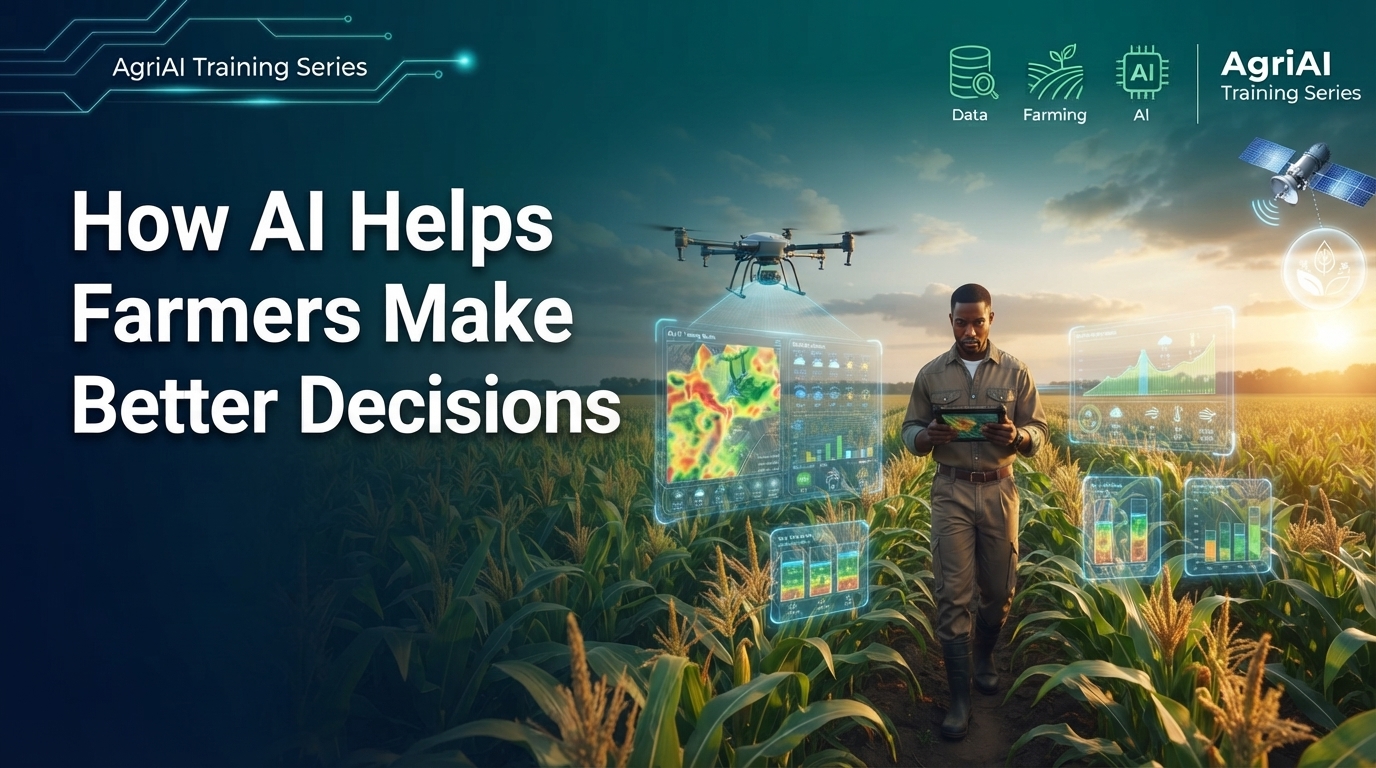
AI does not replace the farmer's judgment. It gives farmers more information, earlier warnings, and better tools to decide what to look at, what to prioritize, and what action to consider next. From: Data → Information → Insight → Action The future of agriculture is not farmers versus AI. It is farmers + intelligent technology working together to make better decisions.
Estimated Duration: 45 Minutes
Prerequisites: Course 01: What Is AgriAI? How Artificial Intelligence Is Transforming Agriculture
Introduction: From Reactive to Proactive Farming (5 Minutes)
Welcome back! In Course 01, we defined AgriAI and explored its foundational technologies. Today, we bridge the gap between theory and daily practice.
Every day, farmers make important decisions. They decide when to plant, irrigate, apply fertilizer, protect crops from pests, harvest, store products, and sell them.
Traditionally, these decisions have been based on experience, advice from agronomists, weather forecasts, and observations in the field. These sources of knowledge remain extremely valuable. However, modern agriculture is becoming more complex.
Weather patterns are changing. Production costs are increasing. Water and fertilizer must be used more efficiently. Pest and disease risks can spread quickly. International buyers are demanding higher levels of quality, traceability, and compliance.
Artificial Intelligence can help farmers manage this complexity.
AI does not replace the farmer's experience. Instead, it combines the farmer's knowledge with data from weather systems, satellites, sensors, farm records, market information, GPS mapping, and other sources to support better and faster decisions.
By the end of this course, learners will understand how AI can support agricultural decision-making from the planning stage through production, harvest, and commercial activities.
Learning Objectives
By the end of this 45-minute course, learners should be able to:
Understand how AI supports agricultural decision-making.
Explain how AI combines multiple sources of agricultural data.
Use AI-supported weather and climate information to improve farm planning.
Understand how AI can support irrigation and water management.
Identify how AI helps detect crop stress, pests, and diseases.
Understand how AI can support fertilizer and input decisions.
Use AI-generated recommendations while applying human judgment.
Understand the importance of farm data for improving future decisions.
Recognize the limitations and risks of AI recommendations.
Understand how platforms such as Five Pillars AgriAI can integrate multiple decision-support tools into one agricultural ecosystem.
Module 1: From Data to Better Decisions
Estimated Duration: 5 Minutes
Agriculture produces an enormous amount of information.
A single farm may generate or receive data about:
Weather
Rainfall
Temperature
Soil conditions
Crop varieties
Planting dates
Fertilizer applications
Irrigation
Pest and disease observations
Satellite imagery
GPS coordinates
Previous yields
Input costs
Market prices
The challenge is not simply collecting this information.
The real challenge is turning information into a useful decision.
For example, a farmer may know that heavy rain is expected. But that information alone does not necessarily answer important questions.
Should planting continue?
Should irrigation be stopped?
Should fertilizer application be postponed?
Could machinery damage wet soil?
Is there an increased risk of fungal disease?
AI can help connect these different pieces of information.
The AI Decision-Support Process
A simplified AI decision-support process can be described in five stages:
1. Collect Data
The system receives information from multiple sources.
2. Analyze Patterns
AI identifies relationships, trends, and possible risks.
3. Generate Predictions
The system estimates what may happen under different conditions.
4. Recommend Actions
AI translates predictions into practical recommendations.
5. Learn From Results
The farmer records what happened, allowing the system to improve future recommendations.
The goal is to move from:
Data → Information → Insight → Action
This is one of the most important principles of AgriAI.
Module 2: Hyper-Local Weather Intelligence
Estimated Duration: 7 Minutes
Traditional public weather forecasts usually cover large geographic areas.
However, agricultural conditions can vary significantly within a relatively short distance.
A field located in a valley may experience colder temperatures than a nearby field located on higher ground.
One part of a farm may receive significantly more rainfall than another.
Wind patterns, humidity, soil moisture, elevation, and surrounding vegetation can also create local differences.
This is where AI-supported hyper-local weather intelligence becomes valuable.
2.1 Micro-Climate Predictions
AI systems can combine information from:
Weather stations
Satellite data
Historical weather records
Atmospheric models
Farm GPS coordinates
Elevation data
Soil information
The objective is to generate forecasts that are more relevant to a specific agricultural location.
For example, instead of receiving only a general forecast saying:
"Rain is expected tomorrow."
A farmer may receive a more useful agricultural recommendation such as:
"Heavy rainfall is likely in your farm area during the next 24 hours. Postpone planting and avoid heavy machinery to reduce the risk of soil compaction."
The difference is important.
The first message provides information.
The second message supports a decision.
2.2 Extreme Weather Alerts
AI can also help identify conditions associated with agricultural risks, including:
Frost
Heat stress
Heavy rainfall
Strong winds
Drought
Hail
Flooding
The value of an alert depends not only on predicting an event but also on providing enough time to prepare.
For example:
AI Alert:
"Temperature may fall below the critical threshold for your crop during the next 12 hours. Consider activating available frost-protection measures and monitor vulnerable fields."
Another example:
"Heavy rainfall is expected within 36 hours. Delay fertilizer application to reduce the risk of nutrient loss through runoff."
The AI system is therefore helping the farmer answer two questions:
What is likely to happen?
And more importantly:
What should I consider doing about it?
Module 3: AI and Irrigation Decisions
Estimated Duration: 6 Minutes
Water is one of the most important resources in agriculture.
Too little water can reduce crop growth and yield.
Too much water can damage roots, increase disease risk, waste energy, and cause nutrient loss.
Traditional irrigation schedules may apply the same amount of water at regular intervals. However, crop water requirements can change depending on:
Temperature
Rainfall
Humidity
Wind
Soil type
Crop growth stage
Root development
AI can combine these factors to support more precise irrigation decisions.
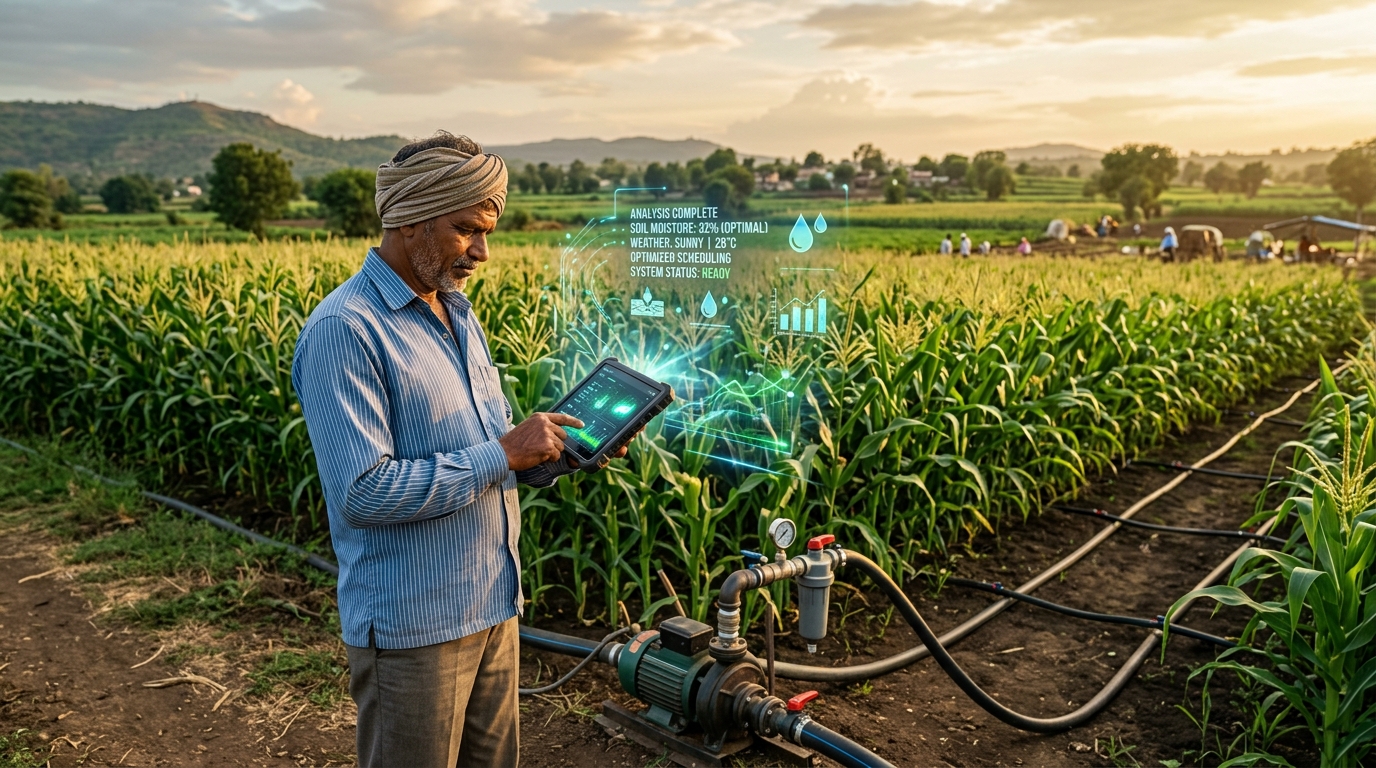
Example
An AI system may analyze:
Soil moisture: 28%
Rainfall forecast: 25 mm within 24 hours
Current crop growth stage
Temperature forecast
Historical water consumption
Instead of following a fixed irrigation schedule, the system might recommend:
"Postpone irrigation for 24 hours. Rainfall is expected to provide sufficient water. Reassess soil moisture after the rainfall event."
This can help farmers reduce:
Water consumption
Energy costs
Labor requirements
Over-irrigation
However, AI recommendations should always be adapted to local farm conditions and the irrigation infrastructure available.
Module 4: AI for Crop Monitoring
Estimated Duration: 6 Minutes
Farmers cannot always inspect every part of every field every day.
Large farms may cover hundreds or thousands of hectares. Even smaller farms can contain areas that are difficult to monitor regularly.
AI can support crop monitoring through technologies such as:
Satellite imagery
Drone imagery
Smartphone photographs
Field sensors
GPS mapping
These tools can help identify variations in crop performance.
For example, AI may detect areas where vegetation appears weaker than surrounding areas.
This does not automatically mean that the crop has a disease.
The problem could be caused by:
Water stress
Nutrient deficiency
Pest damage
Disease
Poor germination
Soil variability
AI can help identify areas that require further investigation.
The farmer or agronomist can then inspect the affected area.
This is an important principle:
AI can help farmers know where to look first.
Instead of walking across an entire farm, the farmer can prioritize areas where the system has detected unusual conditions.
Module 5: Early Detection of Pests and Diseases
Estimated Duration: 5 Minutes
One of the most valuable applications of AI is early risk detection.
Many crop problems become more expensive and difficult to manage when they are discovered too late.
AI-powered image analysis can examine photographs of:
Leaves
Fruits
Stems
Roots
Seeds
The system can compare visible patterns with large collections of agricultural images.
For example, a farmer may take a photograph of a damaged cassava leaf.
The AI system may identify visual characteristics associated with:
Pest damage
Nutrient deficiency
Fungal infection
Viral disease
The system can then provide possible explanations and recommend further actions.
For example:
"The image shows symptoms consistent with possible disease or pest damage. Inspect surrounding plants and consider consulting an agronomist for confirmation."
It is important to understand that AI should not automatically replace professional diagnosis.
A photograph may be unclear. Different problems can produce similar symptoms.
Therefore, AI should be treated as a decision-support tool, especially when the consequences of an incorrect diagnosis could be significant.
Module 6: Smarter Fertilizer and Input Decisions
Estimated Duration: 5 Minutes
Applying more fertilizer does not always mean producing more crops.
Excessive fertilizer application can increase costs and may contribute to:
Nutrient loss
Water pollution
Soil imbalance
Reduced efficiency
AI can help analyze information such as:
Soil test results
Crop type
Growth stage
Historical yields
Weather forecasts
Previous fertilizer applications
Based on this information, the system may support decisions about:
When to apply fertilizer
Where fertilizer may be needed
Whether application should be delayed
Whether certain areas of the farm require additional investigation
For example:
"Heavy rainfall is expected tomorrow. Consider postponing nitrogen application to reduce the risk of nutrient loss."
Or:
"Satellite analysis indicates lower crop performance in the northern section of the field. Conduct soil and crop inspection before applying additional inputs."
This approach supports a transition from:
Applying the same treatment everywhere
to:
Applying the right intervention where and when it is needed.
Module 7: AI as a Prescriptive Agronomy Assistant
Estimated Duration: 5 Minutes
Predicting a problem is useful.
But helping the farmer decide what to do next can be even more valuable.
This is known as prescriptive decision support.
A predictive system may say:
"There is an 80% probability of heavy rainfall."
A prescriptive agricultural system may say:
"Heavy rainfall is likely within the next 48 hours. Delay planting until soil conditions improve. Avoid heavy machinery to reduce soil compaction."
AI can therefore connect:
Prediction + Farm Conditions + Crop Stage + Recommended Action
Consider another example.
The AI system detects:
High humidity
Increasing rainfall probability
A crop at a disease-sensitive growth stage
The system may recommend:
"Weather conditions may increase disease risk. Inspect the crop during the next 24 hours and follow your approved crop protection and integrated pest management procedures."
The objective is not simply to generate alerts.
The objective is to help farmers prioritize actions.
Module 8: AI and Human Decision-Making
Estimated Duration: 3 Minutes
AI can analyze large amounts of data quickly.
However, the farmer still understands important factors that may not exist in the database.
For example:
A drainage channel may recently have been damaged.
An irrigation pump may not be functioning.
Labor may not be available.
A particular field may have a history of flooding.
The farmer may know that a local weather pattern behaves differently from the general forecast.
For this reason, the best approach is:
Farmer Experience + Agronomic Knowledge + AI Analysis = Better Decisions
AI should support human decision-making rather than blindly replace it.
Farmers should ask:
Does this recommendation make sense for my farm?
Is the data accurate?
Has something changed in the field?
Should I inspect the area before taking action?
Do I need advice from an agronomist?
Good agricultural decisions require both technology and human judgment.
Module 9: Learning From Farm Data
Estimated Duration: 2 Minutes
Every agricultural season creates new information.
If farmers record:
Planting dates
Seed varieties
Input applications
Weather events
Pest outbreaks
Yields
AI systems can use this information to identify patterns over time.
For example, after several seasons, the system may identify that:
A particular variety performs better under certain conditions.
One section of the farm consistently produces lower yields.
Planting after a specific rainfall pattern produces better results.
Certain weather conditions are associated with increased disease risk.
The more accurate and well-organized the farm data, the more useful AI decision support can become.
This is why digital farm records are becoming increasingly important.
Module 10: Practical Decision Scenario
Estimated Duration: 4 Minutes
Let us consider a practical example.
A maize farmer plans to apply fertilizer on Monday.
The AI system analyzes:
Current soil conditions
Weather forecasts
Rainfall probability
Crop growth stage
Previous fertilizer applications
The system identifies a high probability of heavy rainfall within the next 24 hours.
Instead of simply displaying the weather forecast, the AI generates a recommendation:
Recommendation: Delay fertilizer application by 48 hours. Heavy rainfall may increase nutrient loss. Reassess field conditions after the rain before applying fertilizer.
The farmer then considers additional factors.
The farmer knows that:
The fertilizer is already available.
Labor is scheduled.
The field has good drainage.
The farmer may decide to inspect the field and consult an agronomist before making the final decision.
This demonstrates the correct relationship between AI and the farmer.
AI provides analysis.
The farmer makes the final decision.
Key Principles for Using AI in Agriculture
When using AI-supported recommendations, farmers should remember the following principles:
1. Good Data Produces Better Recommendations
Incorrect or incomplete information can produce unreliable results.
2. AI Recommendations Are Not Automatic Commands
The farmer should evaluate recommendations before acting.
3. Local Knowledge Remains Valuable
AI may not understand every local condition.
4. Verify Important Risks
Major decisions should be supported by field inspection, agronomic expertise, or additional data where appropriate.
5. Record Results
Documenting what happened after a decision helps improve future planning.
Course Summary
Artificial Intelligence can help farmers transform agricultural data into practical decisions.
Instead of relying only on general forecasts or manual field observation, farmers can use AI to analyze:
Hyper-local weather conditions
Climate risks
Soil and water conditions
Crop health
Pest and disease risks
Fertilizer requirements
Historical farm performance
The real value of AI is not simply its ability to predict what may happen.
Its greatest value is helping answer:
What should I look at? What should I prioritize? And what actions should I consider next?
AI can help farmers make decisions that are:
Faster
More informed
More precise
Better adapted to changing conditions
But AI is most effective when combined with the farmer's own experience and professional agricultural knowledge.
The future of agriculture is not a choice between farmers and artificial intelligence.
It is a partnership between human experience and intelligent technology.
Final Takeaway
AI does not replace the farmer's judgment. It gives the farmer more information, earlier warnings, and better tools to make confident decisions.
Next Module
Next, we will explore how AI can help farmers monitor crop conditions, detect early signs of pests and diseases, and transform images and field data into practical agricultural recommendations.
Course Prepared by Mr. Kosona Chriv on September 2, 2026.
Documents
Five Pillars AI Academy provides free online courses designed to help professionals, farmers, cooperatives, agribusinesses, processors, traders, exporters, and other stakeholders in the agricultural value chain understand and apply Artificial Intelligence in their daily work.
Our curriculum covers eight key areas:
1. 🌱 AgriAI Fundamentals
Learn the foundations of Artificial Intelligence and discover how AI is transforming modern agriculture—from farming and processing to trade and market intelligence.
2. 🤖 AI for Agribusiness
Discover practical AI applications for agribusiness management, sales, marketing, finance, decision-making, customer engagement, and business growth.
3. 📊 AI-Powered Agricultural Operations
Learn how AI, data, IoT, and automation can optimize farming, production, quality control, resource management, and operational performance.
4. 🌍 Global AgriTrade & Export Compliance
Learn how AI-powered tools can support international agricultural trade, market intelligence, documentation, traceability, and export compliance.
5. 🏭 AI Factory & Smart Processing
Explore how AI, computer vision, automation, and real-time data can transform agro-processing facilities into smarter, more efficient, and more profitable operations.
6. 🚜 AI for Cooperatives & Farmers
Discover how farmers and cooperatives can use AI for crop monitoring, disease detection, production planning, market access, pricing intelligence, and better decision-making.
7. 📦 AI-Powered Supply Chain
Learn how AI can improve agricultural supply chains through demand forecasting, logistics optimization, inventory management, traceability, quality control, and risk management.
8. 🎓 Five Pillars Professional Certifications
Develop industry-focused knowledge and practical skills in AgriAI, smart agriculture, agribusiness, international trade, and AI-powered operations.
🌍 Who is it for?
Our free training is intended for everyone working in or supporting the agricultural value chain, including farmers, cooperatives, agribusiness professionals, processors, traders, exporters, logistics professionals, consultants, students, and agricultural organizations.
🎓 100% Free Training
All courses are provided free of charge, with the goal of making practical AgriAI knowledge accessible to people and organizations around the world.
👉 Explore the free curriculum: https://academy.adalidda.com
Learn AI. Apply AI. Transform Agriculture. 🌱🤖🌍
Mr. Kosona Chriv is the Founder of Five Pillars AgriAI, Five Pillars AI Park, and Five Pillars AI Academy—three complementary initiatives designed to accelerate the digital transformation, industrialization, and global competitiveness of the agricultural sector.
Five Pillars AgriAI
Five Pillars AgriAI is an enterprise-grade, multi-tenant AgriAI platform designed to digitize agricultural and agribusiness operations and transform agricultural data into actionable intelligence.
The platform connects the entire agricultural and export value chain—including production planning, quality management, compliance, traceability, logistics, communication, sales, and executive intelligence—within one integrated digital ecosystem.
Built around the Five Pillars Framework, Five Pillars AgriAI helps agricultural organizations strengthen:
Production Planning and Volume Consistency
Quality Management and Compliance
Traceability and Due Diligence
Logistics and Documentation
Digital Communication and Export Readiness
By combining AI-powered recommendations, GPS polygon mapping, agricultural traceability, compliance management, multilingual communication, Vision AI, Voice AI, sales intelligence, and executive analytics, Five Pillars AgriAI enables farmers, cooperatives, agribusinesses, processors, exporters, and agricultural institutions to improve operational efficiency, build buyer confidence, and compete more effectively in international markets.
Five Pillars AI Park
Five Pillars AI Park extends the Five Pillars AgriAI technology framework beyond individual agricultural organizations into a complete AI-enabled agro-industrial ecosystem.
The concept integrates agricultural supply chains, value-added processing, renewable energy, circular-economy solutions, AI data centers, digital infrastructure, logistics, traceability, and international market access within a unified agro-industrial park.
At the heart of the Park is the concept of the AI Factory—where advanced AI, edge computing, IoT, computer vision, automation, and real-time data intelligence support agricultural processing and industrial operations.
The Five Pillars AI Park is therefore not simply an industrial park. It is a new model of AI-enabled agricultural industrialization, designed to connect farmers, factories, technology, renewable energy, global markets, and digital intelligence within one integrated ecosystem.
Five Pillars AI Academy
Five Pillars AI Academy provides free and accessible training courses for everyone involved in the agricultural value chain.
The Academy is designed to empower farmers, agricultural professionals, cooperatives, agribusinesses, processors, exporters, government institutions, students, and other stakeholders with the knowledge and practical skills needed to understand and leverage AI, digital technologies, traceability, compliance, agricultural management, and export readiness.
Through education and capacity building, Five Pillars AI Academy supports the wider adoption of the Five Pillars Framework and helps prepare the agricultural workforce for the rapidly evolving digital and AI-driven economy.
Technology Licensing, Partnerships and Sponsorship
Five Pillars AgriAI, Five Pillars AI Park, and Five Pillars AI Academy offer opportunities for technology licensing, strategic partnerships, enterprise deployment, government and institutional collaboration, project development, training, sponsorship, and agricultural digital transformation initiatives.
For technology licensing, strategic partnerships, project collaboration, sponsorship, enterprise deployment, training, or other business opportunities, please contact Mr. Kosona Chriv directly through the contact information below:
Mr. Kosona Chriv
Founder, Five Pillars AgriAI
Founder, Five Pillars AI Park
Founder, Five Pillars AI Academy
WhatsApp: +234 904 084 8867 (Nigeria) | +855 10 333 220 (Cambodia)
Website: https://adalidda.com
LinkedIn: linkedin.com/in/kosona
YouTube: https://www.youtube.com/@FivePillarsAgriAI
TikTok: https://www.tiktok.com/@kosonachriv
LinkedIn Group: "Five Pillars AgriAI" — https://www.linkedin.com/groups/37080204/
Five Pillars AI Academy: https://academy.adalidda.com